

Service · A system without binders
Digitalising your management system
No ISO standard requires paper — it requires control. We turn documentation, records and deadlines into an orderly digital system that takes care of versions and reminders by itself.
When it is time to go digital
You will recognise yourself if: documentation sits in binders while the latest version of a procedure circulates by e-mail; calibration, training and surveillance audit deadlines are remembered by heart or live in someone's phone; before an audit you spend two days looking for a record that "was somewhere"; or the same spreadsheet exists in three versions with three different people.
That is not a discipline problem but a tool problem. A paper-based system works as long as one person who knows everything holds it together — and stops the day that person goes on holiday.
What the standard really requires — and what it does not
No ISO standard requires paper. Since the 2015 editions, standards speak of "documented information", not of documents and records as physical objects. The format is your choice.
What is required is control: knowing which version is current and who approved it, who has access and who may edit, being able to find a record when needed, keeping it legible for the required time and having a backup. An orderly digital system meets this more easily than a binder, because it keeps versions and change history by itself.
With signatures, the only question is whether you can prove who confirmed something and when. For the auditor a trail in the system is enough — name, time and the impossibility of silent changes — while a qualified electronic signature is used for documents that leave the organisation.
What we digitalise
One place holding the current version of every procedure and form, with change history and a note of who approved it. Old versions are archived rather than deleted, as the standard requires.
Checklists, goods receipt, maintenance, temperatures — filled in on a phone or tablet where the work is done, with a photo when needed. No copying from paper into a spreadsheet.
Calibration of measuring equipment, expiring training, medical examinations, surveillance audits, certificate expiry — the system alerts you in advance instead of it being discovered at the audit.
Audit plan, checklists, findings, corrective actions with deadlines and responsible persons, and effectiveness checks — all in one flow, with a clear status of what is still open.
Management review inputs collect themselves over the year — complaints, objectives, audit findings, training. The meeting is prepared in an hour, not a week.
Who sees what and who may change what. This also meets the access control requirement that ISO/IEC 27001 states explicitly.
Three levels — you choose by size and budget
Level 1 — an organised cloud and templates
No new software. We sort out the folder structure, naming and version rules, document templates and one shared deadline calendar. The cheapest option, and often quite enough for small organisations.
Level 2 — tools you already pay for
Most companies already have Microsoft 365 or Google Workspace but use it as a file drive. We set up forms, automatic reminders, document approval and simple reports inside it — with no extra licence.
Level 3 — a dedicated platform
For organisations with several sites, several standards or strict client requirements. This is where a platform built specifically for management systems comes in — DNA EQMS, which we work with in cooperation with its developer, NETS d.o.o. from Slovenia. It also covers information security.
DNA EQMS — the platform we work with
When an organisation outgrows spreadsheets and a shared drive, it moves to a tool built specifically for management systems. We carry out digitalisation in cooperation with NETS d.o.o. from Slovenia, the developer of the DNA EQMS platform, which companies in the European Union have been using for years.
It is not just another place to store documents. DNA links documentation, risks, processes, training, meetings and corrective actions into one system, so data for management review and audits collects itself over the year. It runs in the cloud and is accessed through a browser, with nothing to install on your side.
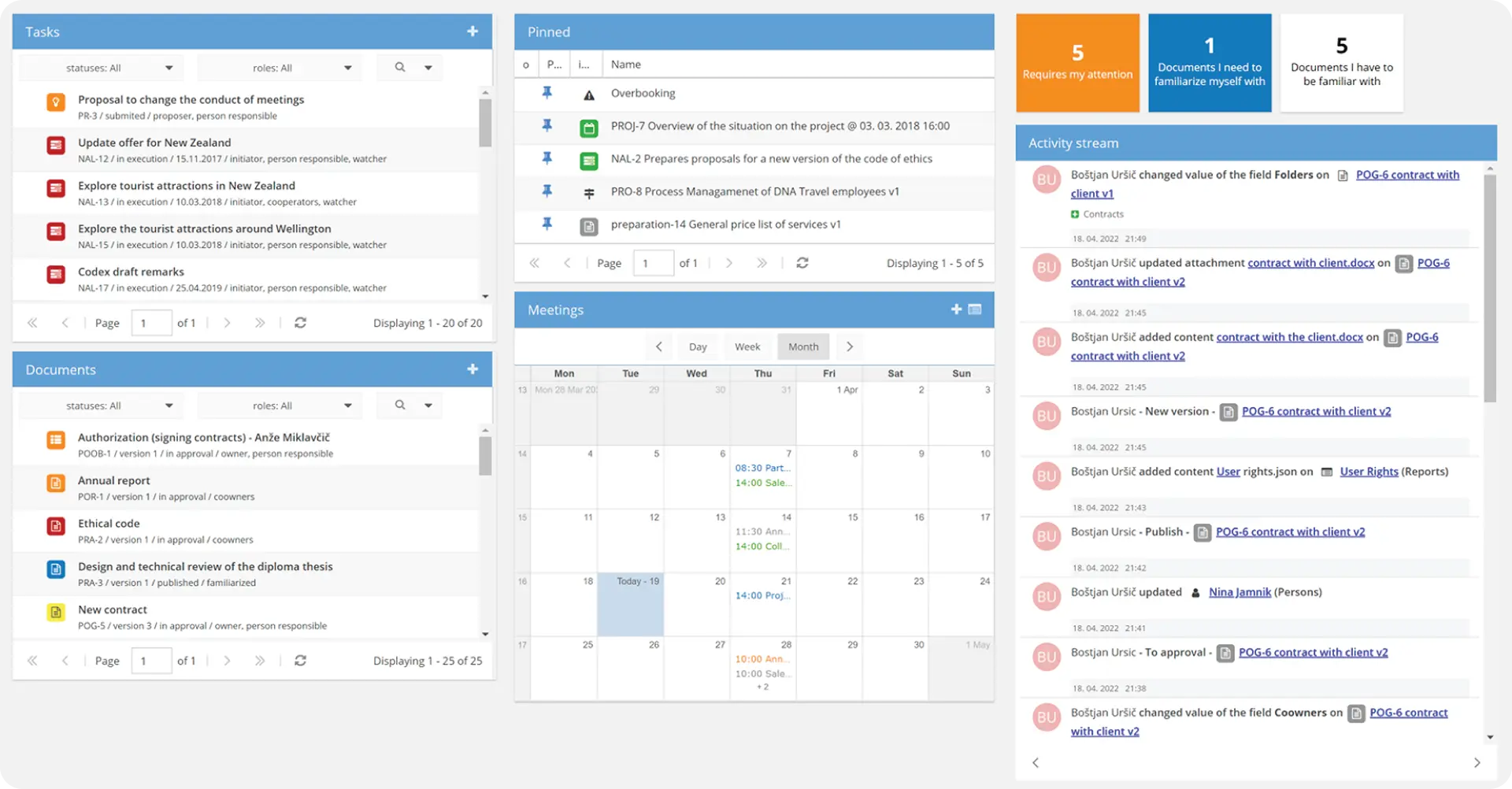
Modules
Versions, approval and role-based access. Every change leaves a trail — who, when and what.
A risk register with owners, ratings and actions. What ISO 9001 requires in clause 6.1, in one place.
Requirements of standards and regulations linked to evidence — at the audit, evidence is pulled up in a minute.
Process map, owners, inputs and outputs, indicators. It connects with process mapping.
Corrective actions, meeting decisions and objectives — with deadlines, responsible persons and effectiveness checks.
Agenda, minutes and the tasks that come out of them. Management review prepares itself.
Training plan, attendance records, competences by job and a reminder when something expires.
Project planning and monitoring within the same system, with no separate tool.
Automatic generation of process documentation, control plans and FMEA — for the automotive industry.
Records of personal data processing, consents and retention periods.
Who already works in DNA
According to the developer, the platform is used by more than 250 companies — from public enterprises and state agencies to pharmaceuticals, energy and the automotive industry. A few names from the client list:
- Impolaluminium, automotive industry
- Civil Aviation Agencystate agency, Slovenia
- Elektro Mariborelectricity distribution
- Saluspharmaceutical wholesale
- Kemofarmacijapharmaceutical distribution
- Sartorius BIA Separationsbiotechnology
- Vodovod-kanalizacijapublic utility company
- Energetika Celjepublic energy company
- Adria tehnikaaircraft maintenance
- Lon, Kranjbank
- Delikomatvending and catering
- Messer Slovenijaindustrial gases
- Precisiumprecision metalworking
- NEC Cerknicadevelopment projects
Since 2018 we have kept our ISO 9001:2015 documentation in DNA. Before that we produced it in Word and Excel and struggled with document codes on our own server — it caused a lot of stress around overview and traceability. Since we started using DNA, ISO 9001 is no longer a big source of stress. Everything is in order, with links between actions, documents, reports and risks, and we spend far less time preparing for external audits because the work is done continuously throughout the year. The auditors are very pleased with the way we present data — it shortens the time they spend searching.
In our business the quality management system is the foundation of everything we do, and we cannot imagine it without proper software support. With DNA we keep all quality system documentation, as well as meetings, projects and GDPR. The system works logically and is easy to use, while meeting strict pharmaceutical requirements.
Managing a large number of processes, standards and related documents is a serious challenge for any organisation. The decision to introduce DNA was a big step forward — only now do we fully see the complexity of our own business model. It is important to stress that DNA clearly defines individual responsibilities within the system.
The testimonials and client list are taken from dnaeqms.com and translated. They are the developer's platform users, not our references — we carry out digitalisation in cooperation with NETS d.o.o.
Frequently asked questions
Do we have to buy software?
No. The first two levels work with what you already have. A dedicated platform only makes sense when the number of sites, standards or users outgrows the tools you already pay for.
Does the auditor accept electronic records?
Yes, and it is common practice. The auditor does not ask for paper but for evidence — that the record was created when it says it was, that it is known who entered it and that it could not have been changed silently. An orderly digital system shows this more easily than a binder.
What about personal data protection?
Digitalisation touches employee data (training, medical examinations), so access rules and retention periods are set up along with it. It is the same work that GDPR and ISO 27701 require.
Whose data is it if we stop working together?
Yours, always. We work in your accounts and your data space. With a dedicated platform, export of all data in an open format is defined in the contract in advance.
How long does the transition take?
Level 1 usually two to three weeks. Level 2 one to two months, because forms are introduced gradually, process by process — so people do not get everything at once and go back to paper.
Do you train staff?
Yes, and that is the most important part. Short role-based training, with a one-page guide for each form. Digitalisation that people do not know how to use goes back to paper within a month.
Related pages
Most often goes together with:
Some of our references
More than 400 organisations in Montenegro and the region have gone through implementation with us — from banks and public bodies to manufacturing, IT, laboratories and hospitality.













These are only some of our clients. More about us →
Is your system still on paper?
Tell us how many people work in the system and which standards you have — we will propose the level that pays off for you. Call us or send an inquiry — we reply within 24 hours.