

Region
The region we work in
Our offices are in Podgorica, Budva and Bijelo Polje, with one opening in Valjevo, Serbia. We work throughout Montenegro and across Serbia, Bosnia and Herzegovina, Croatia, Albania, Kosovo and North Macedonia. The standard is the same everywhere; what differs is the designation, the accreditation body and local regulations.
Where we work from and how far we reach
Everything starts from Podgorica. We are most active in the region, where we work on site; beyond that, work is done online — documentation, workshops and audit preparation do not require anyone to travel.
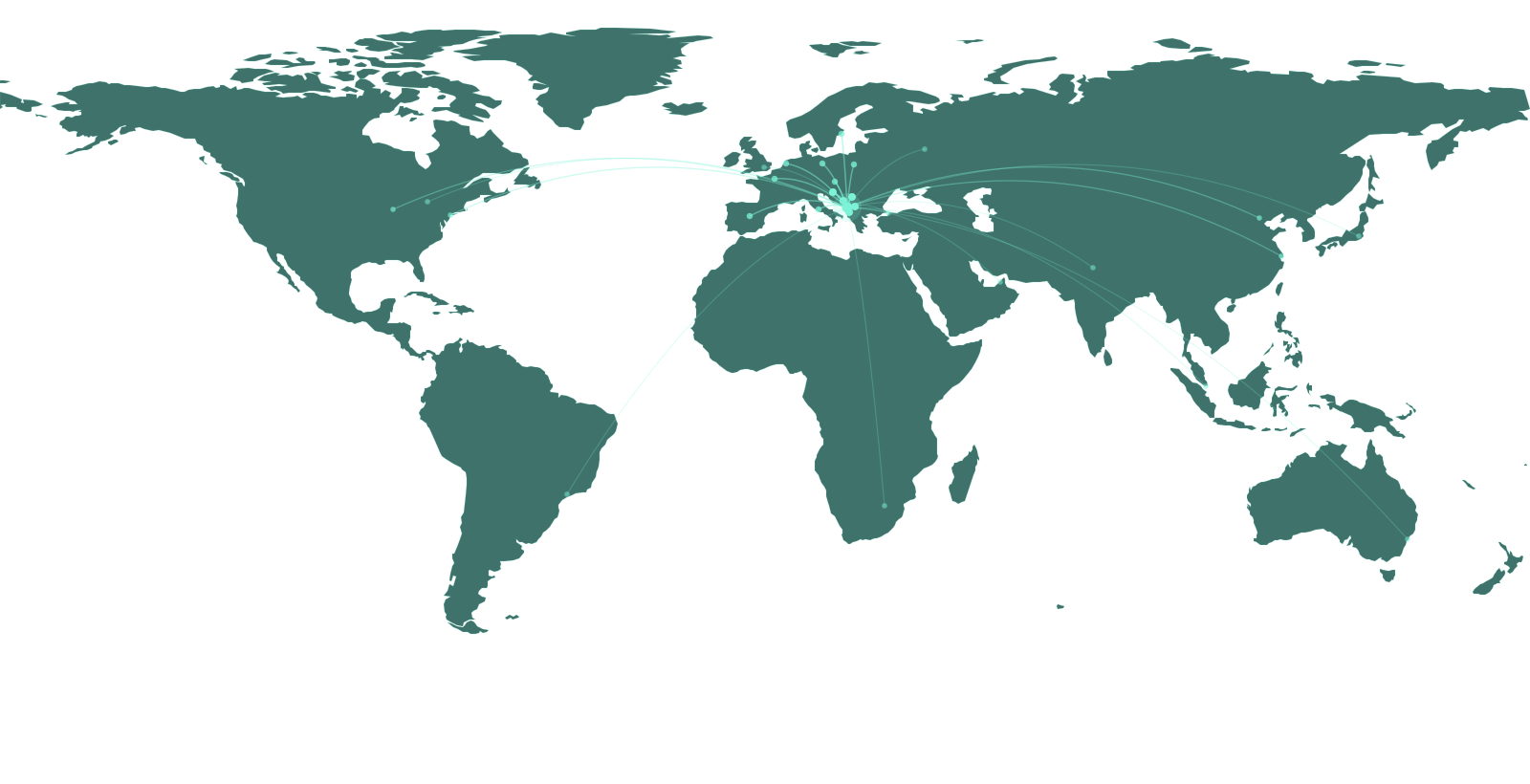
Serbia, Bosnia and Herzegovina, Croatia, Kosovo and Albania. We come to you, with visits planned in advance.
Germany, Italy, France, Austria, Spain, Sweden, the Netherlands, Poland. Work is done online, with site visits when the project requires them.
New York, Chicago, Beijing, Shanghai — most often through the requirements a customer or parent company places on a supplier from our region.
London, Istanbul, Dubai, Moscow, Singapore, Tokyo, Johannesburg, São Paulo, Toronto, Sydney, Delhi. All online, in the language that suits you.
EU, United Kingdom and other countries
Our consultants are mostly from the region — Montenegro, Serbia, Bosnia and Herzegovina, Croatia, Kosovo and Albania — and that is where we work most, in person and on site. That does not mean we are limited to the region: most of the work consists of workshops, documentation and internal audits, which can also be done online. That is why we also work for clients in EU countries and the United Kingdom, as well as for companies from the region that have subsidiaries there or supply goods there.
Workshops, documentation and internal audits are done remotely — no travel, and no gap in your schedule.
We come on site for the initial review, the internal audit and support on the day of the certification audit.
The standard is identical in every country; what differs is the national designation, the accreditation body and the laws that refer to it.
Countries where we work by arrangement
- Slovenia
- Austria
- Germany
- Italy
- Hungary
- Czech Republic
- Slovakia
- Poland
- Romania
- Bulgaria
- Greece
- France
- Spain
- Netherlands
- Belgium
- Ireland
- Sweden
- Denmark
- Finland
- Portugal
- United Kingdom
- Switzerland
- Norway
The list is not closed. If you work in a country that is not listed, get in touch — we will tell you straight away whether and how we can cover the work.
Cities and countries we cover
Next to each country is what really differs there — the national designation of the standard, the accreditation body, the key regulation and what that means in practice for a company doing business or bidding in tenders there:
Montenegro
Our home market and the only one where we have offices. Montenegro is a candidate for EU membership, so domestic regulations are gradually being aligned with European ones — which in practice means ISO standards are increasingly required where they were not before, especially in public procurement and among exporters.
Cities where we work most
- Podgorica
- Nikšić
- Bijelo Polje
- Bar
- Budva
- Herceg Novi
- Pljevlja
- Berane
- Cetinje
- Ulcinj
- Tivat
- Rožaje
- Kotor
- Danilovgrad
- Mojkovac
- Kolašin
- Plav
- Plužine
- Šavnik
- Žabljak
- Andrijevica
- Gusinje
- Petnjica
- Tuzi
- Zeta
Standards we most often implement here
Serbia
The largest public procurement market in the region and the most common reason we get calls from Serbia. Tenders ask for the SRPS designation, but any other accredited certificate is also accepted — a frequent source of misunderstanding that we clear up before the bid is submitted. From Bijelo Polje, this part of Serbia is the closest part of our field area.
Cities where we work most
- Beograd
- Novi Sad
- Niš
- Kragujevac
- Subotica
- Zrenjanin
- Pančevo
- Čačak
- Kraljevo
- Novi Pazar
- Leskovac
- Šabac
- Valjevo
- Užice
- Smederevo
- Vranje
- Kruševac
- Jagodina
- Sombor
- Loznica
- Zaječar
- Vršac
- Požarevac
- Pirot
- Bor
- Sremska Mitrovica
- Kikinda
- Prijepolje
- Priboj
- Sjenica
- Tutin
- Nova Varoš
Standards we most often implement here
Bosnia and Herzegovina
The most important thing to know here is that supervision is not centralised: the state adopts the Food Law and regulations through the Food Safety Agency, while official controls are carried out by entity, cantonal and Brčko District inspectorates. That is why specific obligations differ depending on where the facility is registered — and why a HACCP plan from Serbia cannot simply be copied for BiH.
Cities where we work most
- Sarajevo
- Banja Luka
- Tuzla
- Zenica
- Mostar
- Bijeljina
- Brčko
- Prijedor
- Doboj
- Trebinje
- Bihać
- Travnik
- Zvornik
- Gradačac
- Gračanica
- Cazin
- Konjic
- Visoko
- Široki Brijeg
- Ljubuški
- Čapljina
- Foča
- Bileća
- Gacko
- Nevesinje
- Derventa
- Modriča
Standards we most often implement here
Croatia
The only country in our region that is a member of the European Union, since 2013. That is an important difference: EU regulations apply directly, CE marking is mandatory for products in harmonised areas, and access to EU funds often assumes an established management system. The standard is the same, but the regulatory framework is stricter and more direct.
Cities where we work most
- Zagreb
- Split
- Rijeka
- Osijek
- Zadar
- Slavonski Brod
- Pula
- Karlovac
- Sisak
- Varaždin
- Šibenik
- Dubrovnik
- Bjelovar
- Vinkovci
- Vukovar
- Koprivnica
- Đakovo
- Čakovec
- Samobor
- Kaštela
- Metković
- Ploče
- Korčula
- Opuzen
Standards we most often implement here
North Macedonia
We have no office in North Macedonia — we work online and on site by arrangement. Standards are adopted by the Institute for Standardization (ISRSM) under the MKS designation, and accreditation is run by the Institute for Accreditation (IARNM). The country is an EU candidate, and its law on the security of network and information systems and its personal data protection act are already aligned with EU rules — which is why EU buyers and contracting authorities increasingly ask for ISO certificates.
Cities where we work most
- Skoplje
- Bitolj
- Kumanovo
- Prilep
- Tetovo
- Ohrid
- Veles
- Štip
- Strumica
- Gostivar
- Kočani
- Kavadarci
- Struga
- Radoviš
- Gevgelija
- Kičevo
Standards we most often implement here
Albania
Albania is a candidate for EU membership and a fast-changing market, especially in tourism and the food industry. For clients from Ulcinj and Albanian-speaking areas we also work in Albanian — the whole website exists in that version too.
Cities where we work most
- Tirana
- Drač
- Valona
- Skadar
- Elbasan
- Fier
- Korča
- Berat
- Lušnja
- Kavaja
- Đirokastra
- Saranda
- Lješ
- Pogradec
- Kruja
- Kukes
Standards we most often implement here
Kosovo
We work mainly in western Kosovo, where both the geographical and business ties with Montenegro are strongest. National designations carry the SK prefix, and accreditation is handled by DAK.
Cities where we work most
- Priština
- Prizren
- Peć
- Đakovica
- Mitrovica
- Gnjilane
- Uroševac
- Podujevo
- Vučitrn
- Suva Reka
- Istok
- Dragaš
Standards we most often implement here
Our offices are in Podgorica, Bijelo Polje and Budva. The other cities are places where we have worked or work regularly; we also work where a city is not listed — on site and online. The list is not closed, so if your city is not on it, ask us.
What changes when you cross a border
The standard itself does not change: ISO 9001 in Užice and ISO 9001 in Nikšić have the same requirements and the same clauses. What changes is the framework around the standard.
National designation. The same standard carries a different prefix — MEST in Montenegro, SRPS in Serbia, BAS in BiH, HRN in Croatia, SSH in Albania, SK in Kosovo. That is why tenders feature designations that "don't look the same", although it is the same document. A detailed table of designations is on the page ISO standards in tenders and public procurement.
Accreditation body. ATCG, ATS, BATA, HAA, IARNM, DPA, DAK — all are linked through EA and IAF, so an accredited certificate issued in one country is also valid in another. How this works is explained on the page Certification / ISO certificate.
Local regulations. This is where the differences are greatest and most concrete, especially in food safety: in Montenegro supervision is carried out by the Food Safety Administration, in Serbia by the inspectorates of the Ministry of Agriculture under the Food Safety Law, in BiH by the Food Safety Agency together with entity and cantonal inspectorates, and in Croatia by the Ministry of Agriculture and the State Inspectorate, with HAPIH providing expert support. That is why a HACCP plan is not the same document in every country, even though the Codex principles are identical.
Frequently asked questions about working in the region
Do you also work outside Montenegro?
Yes. Our offices are in Podgorica and Bijelo Polje, and we provide services throughout Montenegro, Serbia, Bosnia and Herzegovina, Croatia, Albania, Kosovo and North Macedonia. Part of the work is done on site and part online — distance is not an obstacle, but we take it into account when planning visits.
What does an on-site visit look like if we are not in Montenegro?
We group visits: gap analysis and verification of the flow diagram require being on site, while documentation, training and audit preparation are mostly done online. For clients in south-west Serbia and Herzegovina we set out from Bijelo Polje, which for most of those towns is one to two hours' drive.
Is a certificate issued in Montenegro recognised in Serbia or BiH?
Yes, if it was issued by an accredited certification body. Accreditation bodies are linked through the EA and IAF MLA agreements, on the principle of "certified once — accepted everywhere". Only the national designation of the standard differs, not the standard itself — more on this on the page ISO standards in tenders and public procurement.
Does the work differ from country to country?
The standard itself is identical everywhere. What differs is the framework around it: the national designation (MEST, SRPS, BAS, HRN, MKS, SSH, SK), the accreditation body (ATCG, ATS, BATA, HAA, IARNM, DPA, DAK) and local regulations — especially for HACCP, where the competent authorities and obligations differ in every country.
Do you also work for smaller companies from smaller towns?
Yes. The size of the organisation affects the scope of work and the price, not whether a standard can be implemented. Some of our clients are companies with one or a few employees who need a certificate for a tender or a customer.
Related pages
Related:
Not sure whether we cover your city?
Tell us where you are and which standard you need — we reply within 24 hours, with a realistic visit plan and no hidden travel costs. Call Call us.